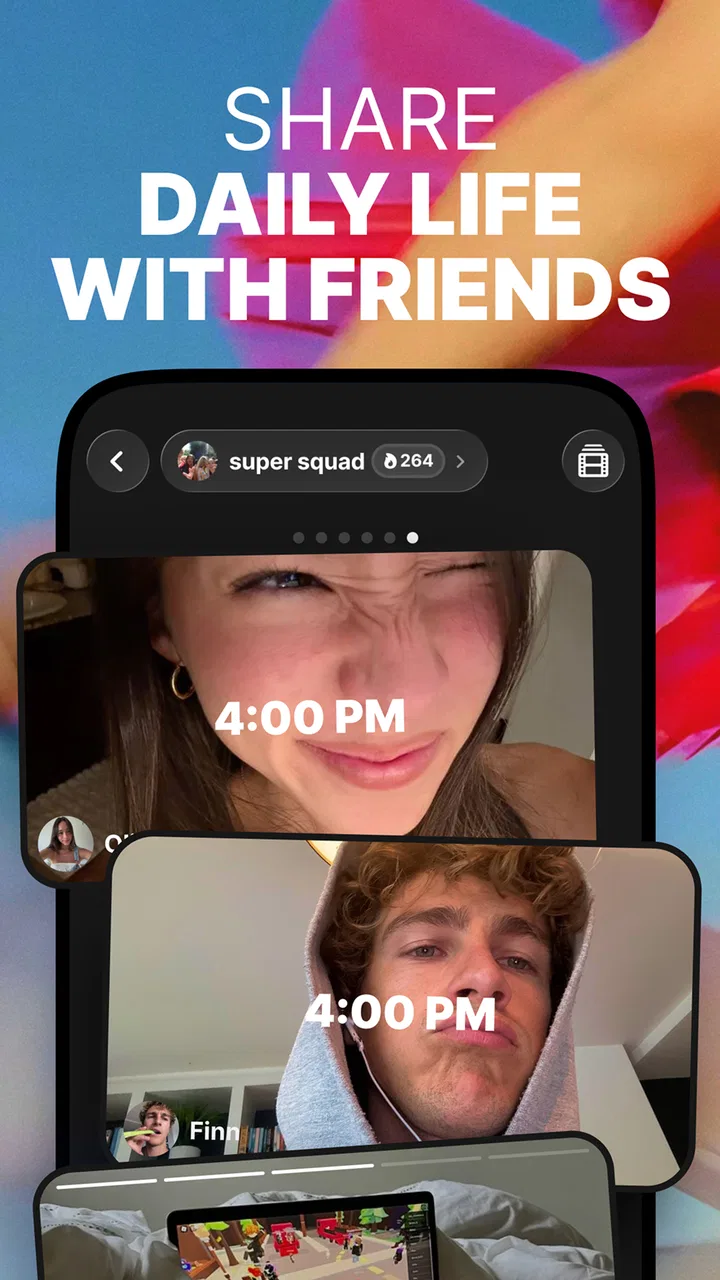
yope: friends-only social game
- 4.8
- Rating
- 5.00M
- Installs
- Free
- Price

 Analysis by App-foxy
I first understood yope as a small, private social space rather than another public feed competing for attention. Its short store description says simply “yope,” while the broader idea is built around sharing real moments with friends. That sounds modest, but it changes how I use it: I am not opening it to follow strangers, chase reactions, or polish a public profile. I am opening it to see what people I actually know are doing right now.
That makes this free lifestyle app from Salo App, Inc. an interesting fit for close groups, especially friends who want a lightweight way to stay present in one another’s days. It is available for Everyone, has reached over five million installs, and holds a 4.8 average from around fifty-nine thousand ratings. Those figures suggest that the simple, friends-first approach has found a large audience, although popularity alone does not guarantee that it will suit every social circle.
After spending time with it, my honest view is that yope works best when a group already has a reason to share regularly. It is less convincing as a replacement for messaging, photo storage, or a broad social network. Its strength is the feeling of a shared stream of ordinary moments. Its weakness is that the experience depends heavily on whether your friends participate consistently.
You May Also Like

 Blood Strike: 2.5 Anniversary
Blood Strike’s Loadouts Turn Every Drop Into a Tactical Gamble
A close look at Blood Strike’s custom loadouts: how fast access to signature weapons reshapes its battle royale rhythm, rewards preparation, and narrows the gap between fights.

 Pandora - Music & Podcasts
Pandora’s Music Is Easy to Start, but Harder to Recover
Pandora’s strength is its low-effort path from a seed to a station. Its weak spot is how much confidence it asks you to place in connection, setup, and quiet recovery.

 8 Ball Pool
 Is Built on Rivalries, Rematches, and Routine
A close look at the rivalries, rematches, shared routines, and unanswered safety questions that turn a quick pool match into a persistent mobile community.

 Samsung Music
’s Quiet Strength Is Playing What You Already Own
Its reach comes less from spectacle than from dependable access to a personal library. That simplicity is both the app’s strongest retention engine and its ceiling.

 AccuWeather: Weather Radar
AccuWeather Review: A Quick, Clear Forecast for Everyday Decisions
For everyday plans, the best forecast is the one you can understand quickly. AccuWeather makes rain timing, radar, and local conditions easy to act on, with a few trade-offs.

 Hill Climb Racing
Why Hill Climb Racing Still Turns Crashes Into One More Run
A tiny car, a bumpy hill and one more upgrade: Hill Climb Racing keeps resurfacing because its simple chaos makes every near-miss feel personal.
More From Our News Desk



How yope feels in everyday use
The most useful way to think about yope is as a casual window into your friends’ lives. Instead of waiting for a carefully written message, I can use it for the kind of small updates that often never make it into a conversation: a coffee before work, a view from a walk, a quick snapshot from a room, or a moment that would feel too minor for a formal post.
That low-pressure quality is important. Traditional social networks encourage me to decide whether something is worth publishing to a wide audience. A group chat, on the other hand, can become noisy when everyone sends frequent photos and comments. Yope sits between those habits. It gives a close group a shared place for current moments without requiring every update to become a full conversation.
A realistic example is a group of university friends who now live in different neighborhoods. One person checks in during a morning commute, another shares lunch, and someone else posts a quick evening scene. Nobody has to write an explanation or keep a discussion alive. When I open the app later, I get a compact sense of the day. That is more intimate than scrolling through public content, but less demanding than replying to several separate messages.
The same setup can work for families, travel groups, roommates, or friends planning a weekend together. It is especially handy when people want to stay connected without arranging a call. I would not describe it as a replacement for a proper conversation, but it can make the gaps between conversations feel smaller.
The trade-off is that the app’s value is social rather than individual. A notes app, camera roll, or private journal can still be useful when I am alone. Yope becomes worthwhile when the right people are there and willing to contribute. If your friends do not want another app, the experience can feel quiet no matter how polished the interface is.
The current experience is intentionally lightweight
I appreciate that the concept does not ask me to behave like a creator. There is no obvious need to build a public identity or plan a content schedule. The appeal comes from immediacy and familiarity, not from collecting followers. For people who dislike the performance aspect of mainstream social media, that distinction matters.
At the same time, “real moments” can mean different things to different users. One friend may post constantly, while another may only appear occasionally. That uneven rhythm can make the shared space feel lively one day and empty the next. I found it better to treat yope as a background connection rather than a service that must deliver something interesting every time I open it.
That mindset also prevents a common disappointment. If I expect a complete messaging platform, a deep archive, or a discovery engine, I am likely to judge it unfairly. The app is more focused: it is about seeing and sharing small pieces of life among friends. Its simplicity is a strength when that is what I want, but it becomes a limitation when I need more control or more communication tools.
What the present version means for new users
The current version is 10.44.0, and the app requires iOS or Android version 11 or newer. For someone deciding whether to try it, that compatibility point is practical: an older device or operating system may prevent installation even though the app itself is free. I would check the phone’s operating system before inviting a whole group, because one person being unable to join can weaken the shared experience from the start.
Since there is no purchase price to overcome, the real commitment is attention and participation. I would not install it alone and wait for it to become useful. A better approach is to begin with a specific circle: close friends, a trip group, or family members who already exchange casual photos. That gives the app a clear purpose instead of turning it into another empty social account.
My practical recommendation is to agree on the kind of sharing you want before adding everyone. Some groups may prefer spontaneous snapshots, while others may use it mainly during travel or around a shared event. Setting that expectation informally avoids the feeling that people must post constantly. It also helps quieter members participate without worrying that they are failing to keep up.
Because the app is rated Everyone, it may be approachable for a broad range of users. Still, an age label does not replace common sense about what a group shares. I would talk with younger users about privacy, screenshots, and who belongs in a private circle. The friends-only idea can feel safer than public posting, but anything shared digitally should still be treated with care.
How it compares with familiar alternatives
Compared with a public social network, yope feels more personal and less exposed. Public platforms are better when I want discovery, broad reach, creators, news, or a large audience. Yope is better when the point is to keep a small group updated without opening the door to everyone else. If I am trying to share a holiday photo with distant acquaintances, a conventional network may be more convenient. If I want my closest friends to see an ordinary moment, yope is the more natural fit.
Compared with a group chat, the difference is less about privacy and more about rhythm. Messaging apps are excellent for direct questions, decisions, plans, and urgent replies. They can become cluttered when many people send images that do not need a response. Yope is more suitable for ambient sharing: updates that friends can notice when they have time. When a conversation is needed, I would still move to a messenger rather than force the social feed to do that job.
Compared with a shared photo album, yope feels more immediate and less archival. Albums are useful when I want to organize important pictures from a trip, preserve memories, or find an image months later. Yope is better for the present-tense feeling of “this is what is happening with me now.” I would use an album for keeping the best photos and yope for the unplanned moments around them.
Compared with a private journal, the app offers connection instead of reflection. A journal gives me complete control and a quiet place to write or record thoughts. Yope gives me a social response simply by placing a moment in front of friends. That makes it motivating for people who enjoy sharing, but unsuitable for anyone who wants their personal record to remain entirely private.
Small workflows that make the app more useful
One useful workflow is to use yope during a temporary shared experience rather than asking it to become a permanent habit immediately. A weekend trip, a birthday week, or a group project can give everyone a natural reason to contribute. I found that this reduces the pressure of inventing content and makes the feed feel connected by context.
A second tip is to use it for moments that would otherwise disappear. The best posts are not necessarily the most attractive ones. A quick image from a rainy walk or a funny detail from a shared day can create a stronger sense of closeness than a carefully edited picture. The app’s value grows when I stop treating each update as something that needs to be impressive.
A third insight is to separate passive connection from active planning. I would share a quick update in yope, but I would not rely on that update as confirmation for a meeting, pickup, or deadline. A casual social stream is easy to miss. For anything important, a direct message remains the safer tool. This simple division prevents confusion and lets each app do what it handles best.
There is also a useful group-management habit: start small. Adding every acquaintance can dilute the sense of closeness that makes the app appealing. A compact circle is easier to understand, and people are more likely to share naturally when they know exactly who will see the moment. If the group becomes too broad, the experience can start to resemble the public feeds it was meant to avoid.
What has changed for existing users
For people who already use yope, the move to version 10.44.0 is best understood as the current stage of an evolving product rather than a reason to expect a completely different social experience. The core appeal remains the same from my perspective: quick, present-focused sharing among friends. I would update because staying on the current version is generally the sensible way to receive the app as its developer maintains it, not because I would assume every update transforms the way the service works.
The release date of June 20, 2022, also gives useful context. This is not a brand-new experiment that has just appeared; it has had time to develop into a recognizable social habit for many users. The large install base and strong average rating reinforce that it is not merely a niche curiosity. Even so, a mature user base does not remove the need to reassess whether the app still fits your group’s communication style.
For an existing group, the biggest effect of any current version is likely practical continuity: friends can keep using the same shared space instead of splitting their updates across unrelated tools. I would pay attention to whether the people I care about are still posting and checking in. If participation has faded, changing apps may not solve the underlying problem; the group may simply need a clearer reason to use one.
New users should also remember that a high rating reflects many individual experiences, not a guarantee of equal satisfaction for every circle. Someone who wants a quiet, close social layer may love it. Someone who wants public reach, detailed organization, or reliable two-way discussion may find the same simplicity frustrating.
Where the experience still has limits
The first limitation is dependence on other people. I can take the initiative, but I cannot create the feeling of a shared community by myself. If only one or two friends post, the app may feel like a personal broadcast tool rather than a mutual space. I would skip it if my intended group is already tired of maintaining multiple social apps.
The second limitation is purpose. Yope is not where I would keep important records, coordinate a complicated event, or have a sensitive conversation. Its casual nature is exactly what makes it pleasant, but casual sharing is not a substitute for searchable planning, detailed replies, or carefully organized storage. People who need those functions will be happier with a messenger, calendar, album, or journal alongside it.
The third limitation is the tension between spontaneity and privacy. Sharing in a close circle feels more comfortable than posting publicly, but I still need to think before uploading a picture that includes another person, a location, or a private setting. The friend-only boundary reduces exposure; it does not eliminate responsibility. I would be selective with anything that could be misunderstood outside the moment.
There can also be a psychological downside to any app built around constant updates. The idea of checking what friends are doing can become a habit rather than a meaningful connection. I found it healthier to open yope when I genuinely wanted a glimpse into the group, not whenever I felt bored. If you are trying to reduce phone checking, this type of live social feed may work against that goal.
Who should try it, and who should pass
I would recommend yope to friends who enjoy casual visual updates but do not want the public pressure of a mainstream network. It is a particularly good match for groups spread across different places, families who like small daily check-ins, and travelers who want to share the in-between moments of a trip. The free price also makes it easy to test with a willing group before deciding whether it deserves a regular place on everyone’s phones.
I would be more cautious if your group mainly communicates through text, needs dependable replies, or already has a well-organized shared album. In those situations, adding another social space may create fragmentation rather than connection. I would also skip it if you want a private diary with no audience, or a public platform where your posts can reach people beyond your existing circle.
The best test is simple: choose a few friends who are genuinely interested, use the app for a defined period or occasion, and notice whether sharing feels natural. Do people contribute without reminders? Do you enjoy checking in without feeling obligated? Does it reduce the need for scattered updates elsewhere? Those answers will tell you more than the rating alone.
My final take on yope
I like yope because it understands that friendship is often maintained through unremarkable moments. It does not need every update to be clever, polished, or widely visible. When the right group uses it, the result feels like a gentle shared presence rather than another stage for performance.
That focus also sets a clear boundary. It cannot fix an inactive group, replace a conversation, or organize memories as thoroughly as a dedicated album. Its value comes from a specific combination: close friends, frequent small moments, and a willingness to share without demanding a response each time.
With Salo App, Inc. behind it and a current version of 10.44.0, the app has developed beyond a passing novelty while keeping its straightforward identity. I would recommend trying it with a real circle of friends rather than judging it in isolation. If your goal is a quieter way to stay present in each other’s everyday lives, yope is worth the experiment; if you need powerful communication or organization, choose a more specialized tool.
FAQs for yope: friends-only social game
01What is Yope and how does it work?
Yope is a friends-only social game designed to enhance your connection with close friends. The app offers interactive games and activities that you can enjoy together. By inviting your friends, you can create a private social circle where you play, chat, and share moments. It's an engaging way to stay connected and have fun.
02Is Yope free to download and use?
Yope is free to download on both Android and iOS platforms. It offers a range of free features to keep you entertained. However, there might be in-app purchases available for premium features or additional content, enhancing your experience within the app.
03What age group is Yope suitable for?
Yope is designed for users aged 13 and above. The app focuses on creating a safe and fun environment for teenagers and young adults. It incorporates privacy settings and parental controls to ensure a secure and enjoyable experience for its users.
04How does Yope ensure user privacy and data security?
Yope prioritizes user privacy and data security by implementing robust encryption methods and privacy settings. Users can control who sees their information, and the app complies with standard data protection regulations. Regular updates help maintain security and address any vulnerabilities.
05Can I play Yope with friends who are not on the app?
To enjoy Yope's full features, your friends need to be on the app. You can easily invite them through various social media platforms or messaging services. Once they join, you can immediately start playing games and sharing experiences within your private circle.
Pros
- Engaging and fun multiplayer challenges.
- User-friendly interface for easy navigation.
- Customizable avatars enhance personal expression.
- Regular updates keep gameplay fresh.
- Strong community support and interaction.
Cons
- Limited offline functionality.
- Some features require in-app purchases.
- Occasional connectivity issues.
- Notifications can be overwhelming.
- Privacy settings need more customization.

yope: friends-only social game
Gallery